I don’t know who thought it would be a good idea to write a book on Spanish culture. Things in Spain keep changing and I keep thinking I should go back to the e-book to update it.
Luckily, now we have blogs. So here is my update for
F is for Fútbol.
Over the next few days we can expect the front pages of Spanish newspapers to demote stories of economic debt, unemployment, corruption, social unrest etc to second place while the country celebrates the victory of La Roja.
A second Eurocup in a row? Unheard of. With a World Champion title squeezed in the middle? Even more unheard of.
I loved the headline in El Mundo newspaper yesterday:
“La España que Cambió el Mundo”. The Spain that Changed the World.
Señores, please, a little bit of perspective.
I can’t underestimate the buzz felt in the country at the moment and it was, let’s face it, a fantastic match. Clean, exciting, exuberant, energetic football, there is no doubt about that. On top of that, the players continue to guide our thoughts to those young stars who are no longer with us by paying homage to them on their white t-shirts (see below and also see F is for Fútbol).
But unfortunately, I’m not sure that this shot of adrenaline will have any long-lasting effects. There has been a lot of money spent by consumers because of the football, great: it would be interesting to know how much public money will be spent as a result of this victory: probably not so great. If we are to believe Aleix Saló, author or Simiocracia, let’s hope that this time the Spanish players leave their bonuses in Spain and don’t deposit them in Austrian banks, as Spain could surely do with the taxes.
Does anyone have the numbers? I’m sure they would provide an interesting read.
Another troubling thought.
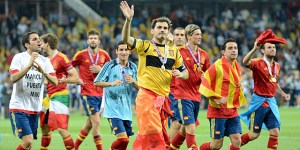
Yesterday, after the team received the cup, what flag did Piqué and Fabregás pull out?
I think in the name of the “happiness bubble” currently covering Spain, the newspapers haven’t picked up on it today. But have a look at this photo (from El Mundo) and you will see a Spain that, far from united, continues to be divided.
It’s here, the Eurocup is finally here. And “La Roja” is playing its first match today.
For a month, we can all look forward to some interesting news about Europe that have nothing to do with the incredibly gloomy, complicated economic situation. Spanish writer Javier Marías, in one of his recent articles defined the championship as a “very welcome opium”, a dose of 90 minutes during which Europeans can get high on football and forget about everything else. (You can read his article in Spanish, here.)
We’ll see whether this is the case. What’s true is that two years ago, Spain won the World Cup and the whole country became united and proud. Here’s how I recall it in The A to Z of Spanish Culture, let’s see what happens this year, in Spain, or anywhere else.
F is for Fútbol
Some of the Spanish league teams are amongst the best in the world, there’s no doubt about it. Unfortunately, the Spanish national team was never glorious… until 2008, when they won the European cup. And then, they did it again in 2010, winning the World Cup.
La Roja
Football fever swept the nation. The goalkeeper, Iker Casillas was referred to as an “héroe nacional” (national hero) on Spanish morning TV shows. La Roja (“the red” squad – luckily the Socialists were in power then) became a symbol of the Spain everyone wanted to see: vivacious, vibrant and victorious.
The national flag began to fly again. No longer a symbol of fascism but of unity and success. The country re-conquered its flag and re-instated the pride in being Spanish.
The Spanish squad represented the country in all its glory: young guys, playing very clean football, persistent and gelling together on the pitch. To top it all up, when Andrés Iniesta scored a goal, his thoughts weren’t on the pitch but back with his friend and colleague Dani Jarque, who had died earlier that year from a heart attack. As he celebrated his goal, Iniesta lifted his shirt to show a white t-shirt underneath with the words “DANI JARQUE, SIEMPRE CON NOSOTROS.” (“Dani Jarque, always will be with us.”)
Unfortunately, Iniesta got sanctioned as the rules forbid removing your t-shirt on the pitch. Still, I’m sure the thrill of winning the world cup made up for that.
The beautiful Casillas, the goalkeeper, had been getting all sorts of unwanted attention from the Spanish press for being in a relationship with an equally beautiful reporter. Just after the match, said reporter interviewed Casillas, asking the usual question of “How does it feel to be king of the world?” Casillas, speechless, could not but express his elation through a full kiss to his girlfriend, on camera. The country cheered at this metaphorical middle finger at those who had said he was under-performing because his girlfriend was watching the matches in the stadiums. (You can watch this for yourself below.)
Against the backdrop of rising unemployment and political corruption left, right and centre, the 2010 World Cup flooded the country with a new wave of hope. The story of this victory had it all: honour, pride, respect, romance, emotion and even the knowledge that Nadal (who became world champion himself just a day later) had celebrated the victory with his fellow sportsmen.
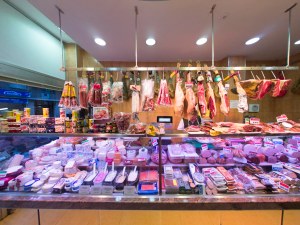
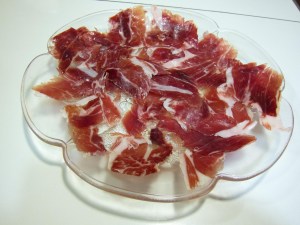
If you adore jamón and happen to be in Madrid, you must pop into the charcutería owned by José Jiménez.
José is an amazing man who used to play tennis with my mother. You will always find him in good spirits, regardless of how hard he’s worked that day and believe you me, he works extremely hard.
If you are looking for any kind of embutidos, or even cheese, you can find a range of products of varying prices here. Ask for them to be vacuum packed (al vacío) if you are just visiting Madrid. If you are buying large quantities of ham ask for several packets, they will last longer.
Many years ago, José was astute enough to grab the opportunity to open his new business. He used to run the charcutería in a supermarket, which decided to raise his rent. As luck would have it, one day a customer told him that her daughter was closing down her small children’s clothes shop and the shop would be available if he wanted to open his own business. He jumped on board and has never looked back. A true entrepreneur.
If you do visit José, make sure you give him recuerdos from Pilar in London.
The Kindle version of The A to Z of Spanish Culture is finally out.
I have also uploaded a version to Smashwords and so it will also soon be available from all e-book stores. I’m on my way to creating the paperback version, for those of you who still prefer to hold your book with both hands.
John Wolfendale in his Eco Vida blog described this blog as a “light-hearted look at Spain”. I think his description is spot on, not just for this blog, but also for the book as a whole.
So, if you fancy something light (and let’s face it, at the moment we need some lightness when thinking about Spain) to give you an insight into Spanish culture, life, history, art, traditions and even its language, click through to Smashwords or the Kindle store now. For £2.88, I hope you enjoy the trip.
Thanks to Twitter I have met a lovely group of people living in Spain who have plenty to share about the country’s past, present and possible future.
If you are looking for people to follow who can give you an insight into what is going on in Spain today, here are some suggestions. (And if you enjoy reading this blog, don’t forget to follow @aspanishculture.)
The highway. That place where you can let your passions run free as you press the accelerator and enjoy the open space.
The Spanish love travelling by car. They use the car to go everywhere. To travel into the city, to get through the city, to get out of the city. A shame, because public transport tends to work rather well. The tube system in Madrid, for example, is fantastic – it’s clean, it runs on time and the carriages have air conditioning in the summer. The train system too can be quite impressive, especially if you are used to travelling in the UK. The carriages are comfortable and the network enjoys some high-speed lines. Though not affordable to everyone the high-velocity train (AVE) and those that use its tracks can save you a lot of time.
Traffic in Spanish cities tends to be as bad as in most European countries. Each city copes as best as it can, sometimes by adopting social norms which make everyone’s lives easier.
For example, in Valencia (which by the way also has a decent public transport system), parking spaces are very scarce. As a result, it is very common to find cars double-parked and sometimes, triple-parked. The valencianos have come up with a way of this being acceptable: double park, but don’t use your handbrake. In this way, if another car wants to leave and you are blocking their way, they can just push your car a bit until they have enough room to get out. Not bad.
Unfortunately, the transport network does not reach every town in Spain and so, the Spanish prefer to travel by car. Friday afternoons are a particularly bad time to leave a city, as everyone seems to be in a rush to escape for the weekend. (Avoid leaving a city around 2pm on a Friday afternoon.) The same goes for the evening before any public holiday.
If you decide to leave the city at the same time as everyone else to make the absolute most of your holiday, you will get stuck for hours in a traffic jam (embotellamiento) or travel en caravana at dangerously high speeds. Travelling en caravana often means driving dangerously fast and dangerously close to other cars. If at any moment anyone has to break, it will lead to the an accident en cadena (in a chain) accidents, common especially in bad weather.
As a result, the beginning and end of every holiday period operación salida (operation: exit) and operación retorno (operation: return) tend to be marked by images of smashed cars on TV and the latest number of fatalities on the road. The only silver lining to this very dark cloud is that as a result, the number of organs available for transplant is quite high. In Spain, you need to opt OUT of the transplant registry if you don’t want to donate your organs when you die.
In 2010, 1,730 people died on the road, but luckily, this number is falling every year as the roads and cars get better. The road system has improved much in Spain over the last 30 years, even to the point that it is rare not to find improvement works on your way when you travel. A journey by car from Madrid to Valencia used to take about 7 hours and can now be done in 3.5. The cars you see on the road are quite decent too. The maximum speed on the highway was reduced in 2011 from 120km per hour, to 110, apparently to reduce petrol consumption. The speed limit was then raised again to 120 km/hr as the traffic police refused to fine those who broke it.
For many years, alcohol seemed to be the car’s best friend. The fact that people drove didn’t seem to deter them from drinking. In the 80s, the artist Stevie Wonder headed the campaign, “Si bebes, no conduscas” (“If you drink, don’t drive.” It should be “conduZcas”, but Stevie turned the ‘z’ into an ‘s’.) I’m not sure it made a difference. Afterwards, the government’s driving campaigns got more and more hard-hitting, to the point that it sometimes becomes unbearable to watch them.
The time when I did notice a change in attitude to drinking and driving was in around 2010, when the government introduced a points system which meant it became easier to lose your licence if you broke the law. Suddenly everyone was drinking less and respecting the speed limit.
Alcohol is still a problem on the Spanish roads and so, every now and then, especially around Christmas time, the traffic police will set out to carry a control de alcoholemia. Police cars will subtly station themselves in street corners to see if they can catch anyone driving in a dangerous manner. So, if it’s your first time driving in Madrid, don’t be tempted to blend in by turning where it’s not permitted or accelerating when the light turns red at a junction – you might get caught by a strategically placed camera or policeman lurking round the corner in their car.
My friend Fidel comes from Alcoy, a beautiful small town on the Mediterranean coast. It is through him that I learnt properly about Moros y Cristianos. Well, through him and his son Alvaro, who very kindly shared with me the school presentation he did on this fiesta.
This Moros y Cristianos tradition recreates a very specific battle that took place in 1276 in Alcoy. On the 23 April, having lost the city to the Kingdom of Valencia (Spain has quite a tradition of division, it was made up of lots of separate kingdoms until 1492) the Moors tried to conquer the city once more under the leadership of “el azul”, (the blue one), Al-Azraq – blue due to the colour of his eyes. A bloody battle ensued between Muslim and Christian troops.
When it seemed inevitable that the Arabs were going to win the battle, a mysterious male figure appeared, riding a white horse and displaying a red cross on his chest. With one blow, the warrior, identified by the Christian troops as St Jordi (patron saint on that day), took the life of the Arab leader, causing the rest of his troops to disperse.
The result of such an important day (the Spanish got their city back) is celebrated in Alcoy over three days no less. This trilogía runs from 22 to 24 April. The first day features different music bands playing through the streets of Alcoy and it ends with the whole town eating an olleta alcoyana, a caserol-type dish including pork, beef, potatoes, beans and morcilla, a kind of sausage made of pig’s blood and meat.
The following day starts early. At 6am, the trumpet sounds and both sets of troops parade through the city as the sun begins to rise. (My friend Fidel has impersonated a Moor for ages.) A beautiful reconstruction of medieval times ensues, with the Christian side parading in the morning and the Moorish side taking over the streets in the afternoon.
The second day is dedicated to St Jordi. It consists mainly of procesiones similar to those seen during Easter, but featuring an image of St Jordi which is carried from church to church.
On the last day, the whole thing explodes. Literally. Gunpowder features heavily on this day as the battle between Moros and Cristianos is reconstructed, showing the Moors victorious in the morning while in the afternoon, the Christians are able to take the city back.
Plenty of noise and celebratory behaviour then, but not nearly as much as that which you can see in Las Fallas in Valencia.
M is for Madrid
Madrid from the rooftops. Loving the contrast between modern, urban Madrid and the old-fashioned “barrio” with the “abuelos”. Thanks Kevin for the pics!
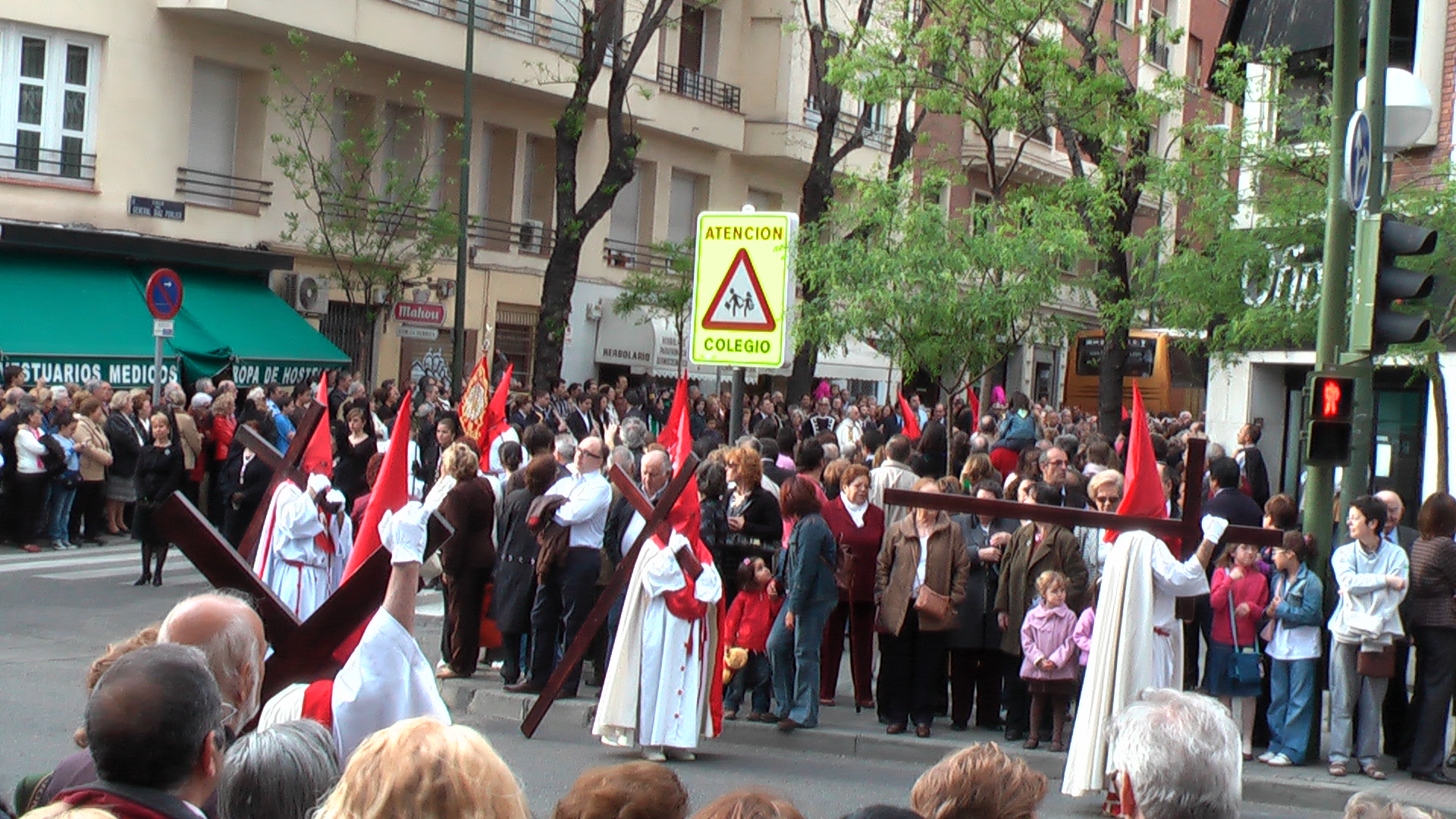
Easter is a really big deal in Spain. You can see procesiones everywhere, where large images of Christ are carried around the city. Unfortunately, Easter is also a time of pain in Spain, as it often rains and the illusions of both those who eagerly await to carry the effigy and those who have been waiting all year to watch them, are shattered.
Here are some pictures from Easter in Madrid, from a few years ago.
And no, they are not tourists from the KKK.


 The A to Z of Spanish Culture