

The podcast of the chapter T is for Tapas is now out.
¡Qué aproveche!
Having been abroad for so long, I didn’t know that the letters CH and LL had been removed as letters from the Spanish alphabet.
They have been banished from the Royal Academy for being just “dígrafos” that is, a sign representing a sound.
So, in order to be faithful to the Spanish alphabet, I have removed the chapter CH is for Chocolate con Churros (will include them in one of the chapters related to food) and have renamed Ll is for Lluvia (rain), P is for Paraguas (umbrella).
Nunca te acostarás sin saber una cosa más.
(You learn something new every day or, literally, you won’t go to bed without knowing one more thing.)
For those of you who speak Spanish, below is what the Real Academia Española had to say in 2010 and here is the link.
Se excluyen definitivamente del abecedario los signos ch y ll, ya que, en realidad, no son letras, sino dígrafos, esto es, conjuntos de dos letras o grafemas que representan un solo fonema. El abecedario del español queda así reducido a las veintisiete letras siguientes: a, b, c, d, e, f, g, h, i, j, k, l, m, n, ñ, o, p, q, r, s, t, u, v, w, x, y, z.
El español se asimila con ello al resto de las lenguas de escritura alfabética, en las que solo se consideran letras del abecedario los signos simples, aunque en todas ellas existen combinaciones de grafemas para representar algunos de sus fonemas.
La eliminación de los dígrafos ch y ll del inventario de letras del abecedario no supone, en modo alguno, que desaparezcan del sistema gráfico del español. Estos signos dobles seguirán utilizándose como hasta ahora en la escritura de las palabras españolas: el dígrafo ch en representación del fonema /ch/ (chico [chíko]) y el dígrafo ll en representación del fonema /ll/ o, para hablantes yeístas, del fonema /y/ (calle [kálle, káye]). La novedad consiste, simplemente, en que dejan de contarse entre las letras del abecedario.
Al tratarse de combinaciones de dos letras, las palabras que comienzan por estos dígrafos o que los contienen no se alfabetizan aparte, sino en los lugares que les corresponden dentro de la c y de la l, respectivamente. La decisión de adoptar el orden alfabético latino universal se tomó en el X Congreso de la Asociación de Academias de la Lengua Española, celebrado en 1994, y viene aplicándose desde entonces en todas las obras académicas.
For those of you with access to BBC2, just thought I’d let you know about the programme “Rick Stein’s Spanish Christmas” out on BBC2 on Weds 21st December at 9pm.
http://www.bbc.co.uk/programmes/b018nslp
¡Qué aproveche!

Traditional turrón (duro). Photo by turronesprimitivorovira.

Turrón blando. Photo by janosizoltan, on Flickr
“Vuelve a casa por Navidad, como el turrón.”
(He/she is coming back for Christmas, like the turrón.)
Can you spot Colón? (Colombus.)
He discovered America 519 years ago today. Can you spot him in his own plaza, in Madrid?

The 12th October is a national holiday in Spain, so if you are thinking of visiting the country on that day, be warned, all the shops will be closed!
So, happy Día de la Hispanidad, everyone. And Happy Saint’s Day to all those called Pilar – and thanks to all of those who remembered that I go by that same name!
In the spirit of the A to Z book, I’ll expand (a bit) on Colón.
Colón is also a very popular detergent in Spain – it’s even got its own song!
Quiero ser un bote de Colón
Y salir anunciado por la televisión.
Sung by the kings of the Movida, Alaska y los Pegamoides.
(For more on La Movida, see the A to Z’s chapter M is for Movida, coming soon…., find out when by clicking here.)
If you are talking about Colombus, make sure that you accent the word, or else you will be talking about his colon.
(Apologies for the slightly odd writing style today – I’m not sure whether I’m supposed to take the day off, being exiled and everything…)
This Wednesday 12th October it’s a holiday in Spain.
The day Colombus discovered America and also the day in which the virgin appeared on top of a pillar – el día del Pilar, my Saint’s day!
So, many people will take Monday and Tuesday off to, thus creating a “bridge” between Sunday and Wednesday, during which they can take time off.
The “puentes” (literally, bridges) are those periods of time when a festive day during the week allows for other days to be taken off.
Happy bridge to all of those in Spain!

Virtual flowers for all those called Pilar.
As someone who used to watch quite a lot of TV as a teenager, I was a great fan of “La bola de cristal”, a tv programme from the 80s (The Crystal Ball).
This programme was aimed at children, teenagers and young adults, targeting each age group by segments. Assuming that the older the person, the later they would be getting up in the morning, La Bola de Cristal structured its content to appeal to an older age group as the programme progressed. (For photos etc, visit the official site http://www.rtve.es/television/la-bola-de-cristal/)

La bruja Averia. Image from official website http://www.rtve.es/television/la-bola-de-cristal/
The ‘electroduendes” (electric elves, see also D is for Duende), were irreverent creatures who artistically portrayed their creators’ political views. For example, the Bruja Averia (The Fault Witch) has a range of slogans including “viva el mal, viva el capital” (Hoorah for Evil; Hoorah for Capital).
Although the form seemed to be aimed at young children (puppets whose puppeteers had trained with Jim Henson), the underlying themes of the Electroduendes were definitely of interest to older viewers.
La Bola de Cristal ended with a segment hosting the most popular pop bands of the time. In fact, the second half of the programme was hosted by Alaska, who with Kaka de Luxe and Alaska y los Pegamoides (‘pegamoides’ has no translation, sorry!) became one of the most famous punk stars in the 80s. (She is still going by the way, still featuring in Spanish culture). Nostalgia for what was an exiting era in Spain can now be satiated through the purchase of DVDs of the series or many You Tube appearances.
If you speak Spanish and would like to find out more about the programme, or just have a look at the videos and pictures, visit http://www.rtve.es/television/la-bola-de-cristal/ For a different type of Spanish TV personality, see E is for Espinete.
(Taken from the chapter M is for Movida.)
A bed of home made chips covered with two (or more) eggs, ready to be smashed or broken allowing the yolk to flow over the chips. Often accompanied by jamon (Spanish ham) or chorizo (Spanish spicy sausage). I’ll never get tired of them.
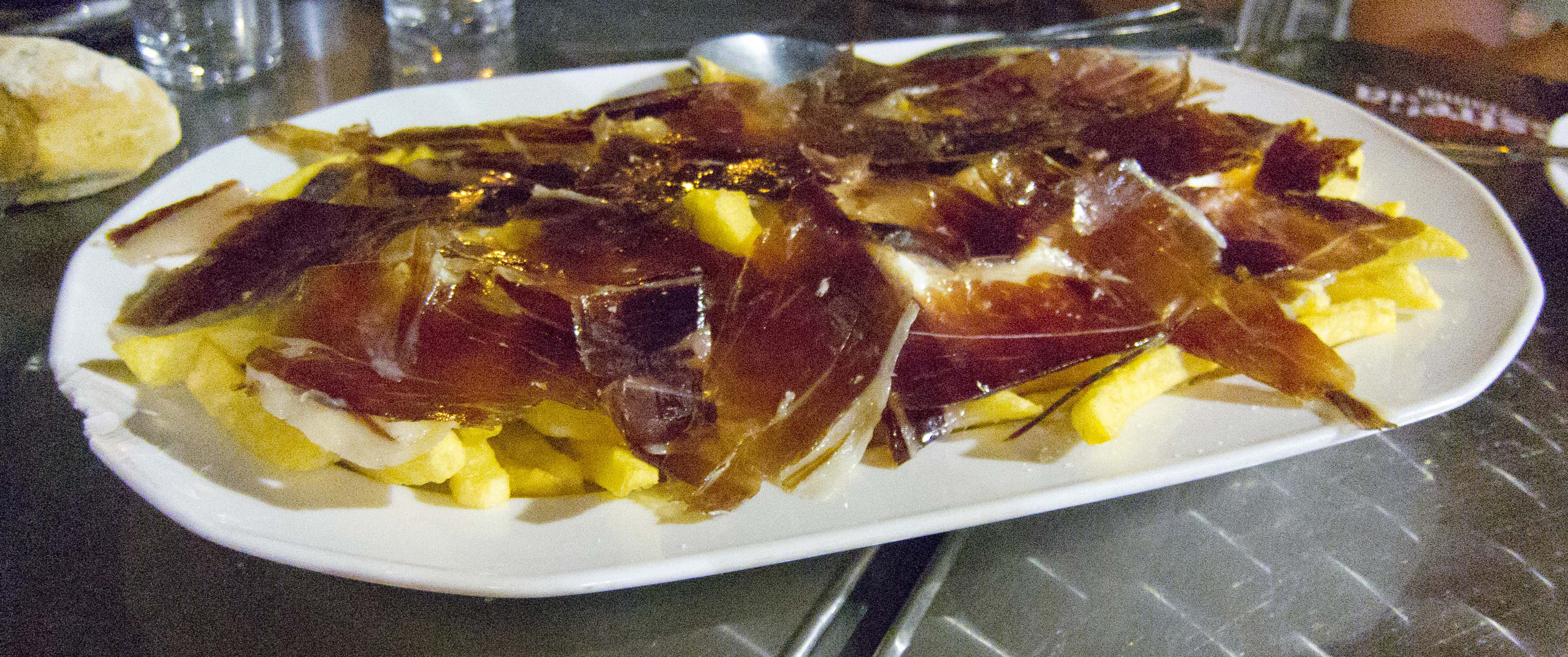
Recommended for those wanting to raise their salt or cholesterol levels.
(Taken from the chapter T is for Tapas.)
“Bodorrio” is one of the colloquial ways for “Boda” – wedding.
It refers to a big wedding – although big in Spain usually means lots of food!!!!! There are not many traditions that take place in Spanish weddings, making the reception more like a big party. First course (primer plato); second course (segundo plato); dessert; cake; coffee etc In addition to all the “aperitivos” you will get before the meal. And then usually, a free bar and lots of dancing until well into the night (4 – 6pm).
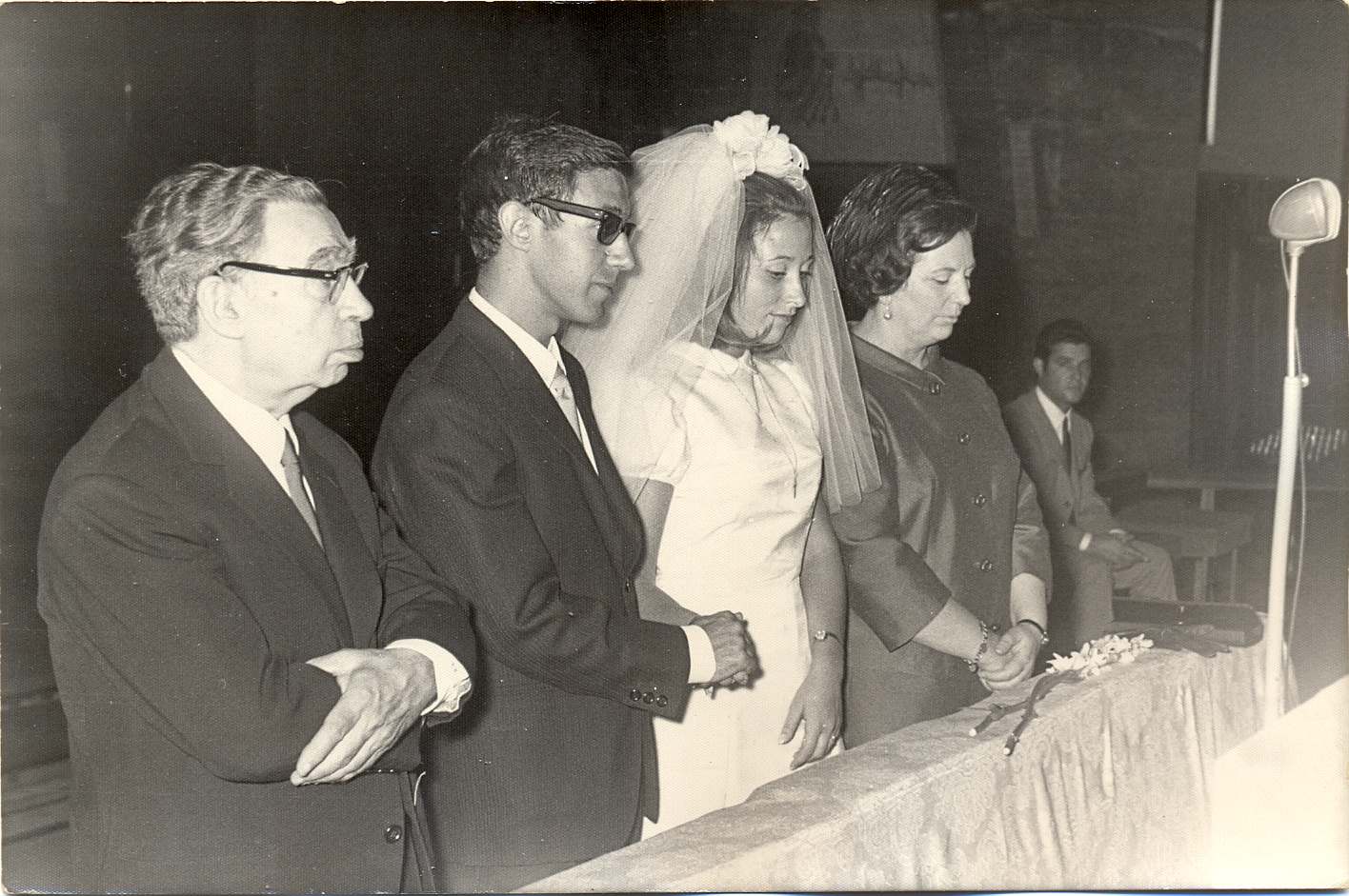
The microphone on the right should give you a clue about this wedding's decade. Things have changed (a bit). Above, my parents and respectives. My mother's mum and my father's dad. Another way in which my parents innovated. Curious as to why?
I do like Spanish weddings, although I think they have become something of a “commercial transaction”. Before I elaborate on this, let me share with you something I read today that prompted me to write this post.
If you are invited to a dinner party, you can bring a gift – flowers, wine, or whatever counts as a friendly gesture. If instead, you leave $100 on the table at the end of the meal, you will destroy the atmosphere because you have turned a social interaction into a commercial exchange.
(Harvard Business Review article “The Unselfish Gene” July/Aug 2011 Fayard & Weeks)
If any of you have ever received a wedding invitation with an account number inside it, you will know what I mean.
Wedding lists are still tradition in Spain, but as couples marry later on in life and already have their 8 piece set of eggholders, their dishwasher and flat TV in place, what use is a Wedding List for them? Much better just to get the cash! So if you are invited to a Spanish wedding, be ready to dish out 100 EURO per head.
Or, if like me, you still prefer to keep this a social occasion, you can choose to ignore all social conventions and give them a personal gift! I haven’t been spat at yet (neither literally nor metaphorically) – at least not to my face.
Do leave your favourite/hated Spanish (or other) wedding traditions here, if you wish. And be ready to shout:
¡¡¡¡VIVAN LOS NOVIOS!!!!
To incite the rest of the guests to shout:
¡¡¡¡VIVAAAAAAAAAA¡¡¡¡¡¡¡
 The A to Z of Spanish Culture