M is for Metro de Madrid

Madrid is very proud of its metro. Or should I say that the Metro de Madrid is very proud of its metro.

I’m always struck by the different slogans the Comunidad de Madrid comes up with. Their latest one, on their website, is

Rápidomodernoecológicocómodoseguro
…vivo

Fastmodernecologicalcomfortablesafe
…alive

I do like the tube system in Madrid very much, so here is a short video for those of you who haven’t been on it before.

Enjoy the ride!

Metro madrid EOS 550D Rebel 2Ti from VJ Cookie / Kevin K on Vimeo.

G is for Guernica

‘El Guernica’ was created as a response to the bombing of the town of Guernica in the Basque country. In April 1937, the German and Italian troops who were helping the rebels under Franco bombed the town with the aim of attacking its civil population. Following the request of the president of the Spanish republic, who still hadn’t succumbed to Franco’s rule, Picasso, already living in France, depicted the massacre in a painting to be shown in Paris that year.
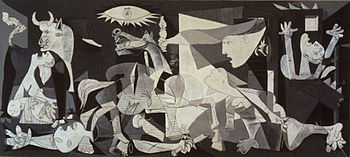
The painting is a large black and white canvas, (3.50m x 7.80m) painted in a recognisable Picasso style (cubism). Picasso didn’t want the painting to return to Spain until the country became a democracy again and so it was housed in the MOMA in New York until 1981. It was then transferred to an annexe in the Prado Museum, the Cason del Buen Retiro. Since 1992, the painting has been hanging in Madrid’s Museo de Arte Reina Sofia, a public museum dedicated to contemporary art.

‘El Guernica’ is an emotive reminder of the horrors of war. As such, it hangs outside the UN’s security council’s entrance in New York. When in 2003, Colin Powell delivered a speech to convince the world of the need to attack Iraq, the copy of the Guernica was covered with a drape.

Picasso had wished for the US to keep his painting safe until Spain became a democracy once more. I wonder what he would have made of this.

During my research for The A to Z of Spanish Culture, I came across this video put together by the national TV channel, about the return of Picasso’s Guernica to Spain.

Unfortunately, I can’t embed the video here, but here is the link.

http://www.rtve.es/alacarta/videos/te-acuerdas/acuerdas-guernica-regresa-espana/1193241/

ENJOY!

O is for Olé

O is for Olé, toros, flamenco, fiestas, sangría, cervezas, mañana…. and any other stereotype you can think of.

My friend Victor shared this link with me through Facebook. (He is a real friend too.)

It challenges the Spanish stereotypes. http://www.guardian.co.uk/world/2012/jan/26/spanish-stereotypes-we-have-mondays-too?

Let me know if you have any favourite ones – those you love as well as those you hate.

P is for Puesta de Sol

From Madrid to Guadalajara.

This is a trip I take quite often, to visit my wonderful family.We’re always stunned by the sunset (puesta de sol) on the way back.

Thanks to Kevin for the pics. (And to my mother, for driving.)

P is for Problema, not Problemo.

I am currently writing the chapter ‘O is for Olé’ and thought I’d share this bit, which addresses why “sin problema” has become “no problemo”.

In Spanish, most words carry with them the feminine or masculine gender. For example, a house (“la casa”) is feminine while the sky (“el cielo”) is  masculine. These two are classic examples of words that, ending in “a” are feminine while words ending in “o” are masculine.

However, sometimes this is not the case.

The exception to the rule (and there are lots of exceptions to the rule in Spain) can be illustrated precisely by the word “problema”. Although ending in an “a”, this is a masculine word: “el problema”, “un problema”, “los problemas”. So, you can see how “problema” has become “problemo” in the mouths of non-native Spanish speakers.

Errant in Iberia. Book Review

I mainly bought this book for inspiration, to see how someone else had tackled the task of giving a taste of Spain to those living outside it.

Errant in Iberia is a novel, so if you fancy being wrapped up in the story of a young man who finds himself in the middle of Spain almost without realising it, go for it! (On the Kindle it is only £1.99!) I especially loved his adventures with the “mancomunidad” in the building where he buys a flat – to see what I’m talking about, have a look at the sample chapter of the A to Z, B is for Barrio.

Ben Curtis’ book is a warm book; it’s an honest book; it’s a funny book.

If you know Madrid, you will love it. If you’ve never been there, it will give you a good idea what life might feel like as a visitor. It’s also interesting to see the protagonist escape Madrid and his vision of some of Spain’s traditions, such as the Fallas.

I have yet to see anything in Spain quite so astonishing as the civic irresponsibilities that take place during Las Fallas. There is something wonderfully liberating about the whole thing, that makes you realise how much the British might benefit if the powers that be were just a little less up-tight about health and safety.

He also describes other lesser know Spanish festivities, such as the “Concurs de Castells” (the castle competition) in Cataluña, the human towers competition.

I’ve certainly been inspired by his book, as well as entertained!

Thanks, Ben!

I is for Inocente

28 December is the “Día de los inocentes” (the day of the innocent).

It is the equivalent of the Anglo-Saxon April’s Fools Day but it has a darker undertone.

The 28 December commemorates the massacre led by King Herod when he ordered the death of all the boys under 2 years old.

However, the day has a very festive tone to it, with people playing all sorts of jokes on each other, setting off fireworks and the media making up the accompanying joke.

Enjoy!